
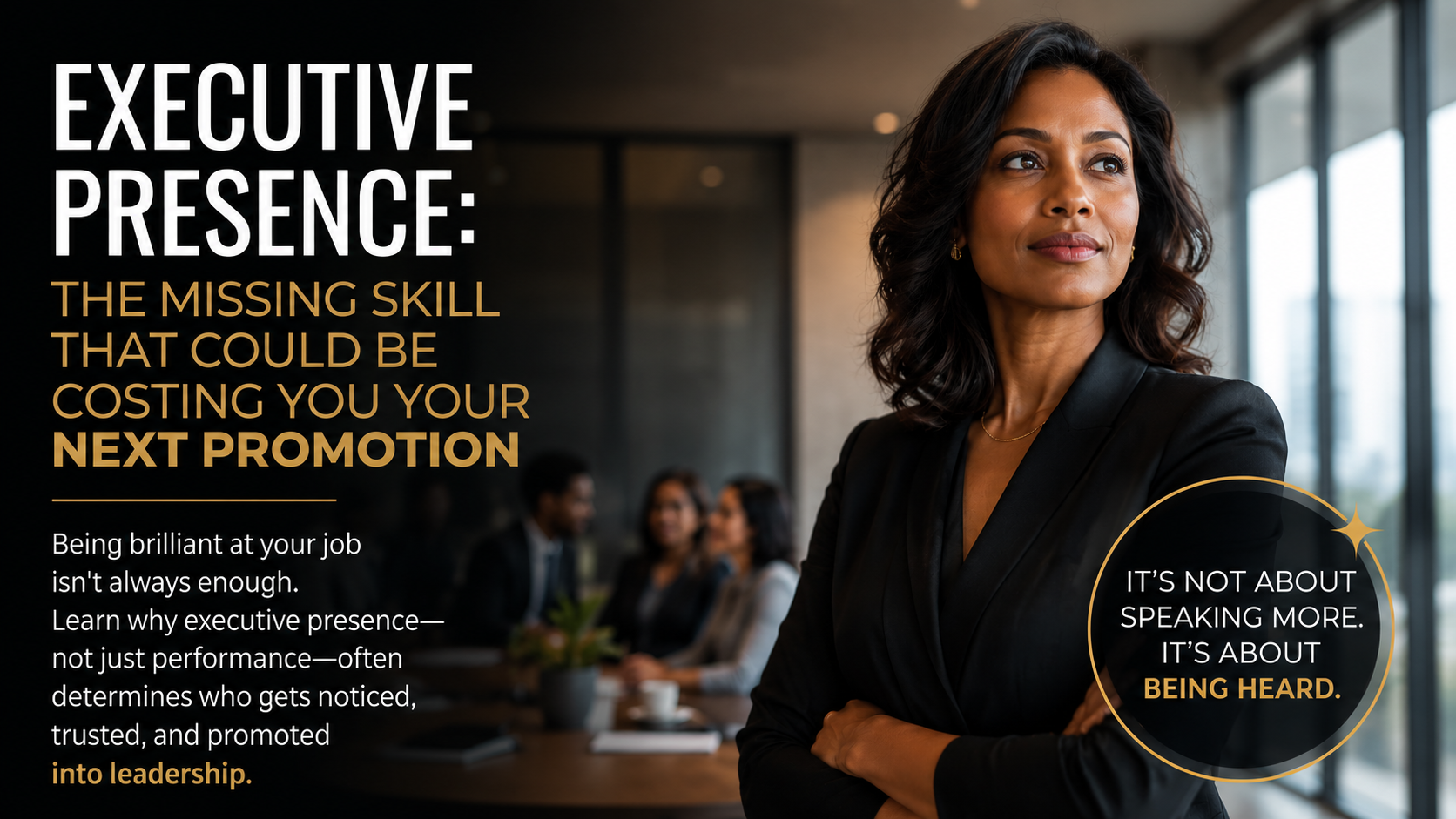
Executive Presence- The Missing Skill That May Be Costing You Your Next Promotion
Why do some highly capable people get promoted while others, who are just as talented, remain overlooked?"
This was the question Brenda and I explored during a coaching engagement.
Brenda was exceptionally good at her job. She was reliable, consistently delivered high-quality work, and was well respected for her expertise. Despite her strong performance she wasn't progressing into senior leadership roles.
During team meetings, Brenda asked a lot of questions, explained her thinking so others could benefit and spoke frequently to demonstrate her engagement and value. She explained that she often started the conversation when no one was talking.
Feedback from her VP, suggested that she lacked Executive Presence.
Most clients believe that being brilliant at their job should be enough to get them promoted. Most clients do not know that Executive Presence often determines who gets noticed, trusted, and promoted into leadership.
Most clients think that Executive Presence is about putting your voice in the room, delivering polished speeches, or displaying charisma.
From my experience, Executive Presence is felt by others and shown in the confidence that they have in how you think, communicate, and show up.
The Power of Slowing Down
I shared my observation - at times, during our coaching call, she spoke very quickly and in those moments I struggled to understand her every word.
She smiled and said that when she got excited or passionate about a topic she spoke quickly. She also shared that she often only had a few minutes to get her contribution in.
When asked “How much of your message may be lost?”
She stopped and said “I never thought about it like that.”
In sessions, I invited Brenda to practice maintaining a moderate talking pace.
She realised that slowing down her speech gave her the advantage of having more thinking time and she could be more selective with her words.
Concise Creates Confidence
Brenda believed that providing more explanation demonstrated her expertise and made her a valuable contributor at meetings.
“How does your VP speak?”
She replied that he was brief and spoke with clarity and precision. He spoke about what matters, what doesn't, and expressed ideas in a few well-chosen sentences.
She realised that her speech pattern contrasted with how he communicated.
From Asking Questions to Adding Perspective
As Brenda reflected on her communication style she had another “Ah Ha”.
Her peers found great value in her questions and often complimented her “ Brenda you ask great questions.”
She admitted that she often knew the answers but asked open ended questions to help others think.
“Which serves your executive presence better? Questions or answers?”
She realised that she was in danger of being perceived as someone who was seeking answers rather than someone providing direction.
“How can you add value to discussions?”
She replied that she could summarise the discussions, highlight a risk, identify a missing perspective or make a recommendation.
With this in mind Brenda began experimenting with “I” statements such as:
· "I notice ....."
· "I think xyz is missing..."
· "My recommendation would be..."
· "What I 'm hearing is..."
· "I believe that…"
Small Changes, Big Difference
By our third coaching session, Brenda reported that she was noticing a shift.
She no longer asked questions or filled the silence. She felt more confident and contributed with greater authority while maintaining a moderate talking pace.
Her colleagues appeared to listen more attentively and her VP gave her positive feedback about her contributions at a meeting.
She was looking forward to an upcoming leadership meeting, where she could demonstrate the Executive Presence she was intentionally developing.
Executive Presence Is a Practice
During our time together, Brenda shifted her belief system.
Before she viewed Executive Presence as a personality trait reserved for a select few.
Now she knows that Executive Presence is a leadership capability that can be developed through intentional practice.
She also knows that it often looks like speaking less, observing more, making thoughtful contributions and slowing down enough for others to see the quality of your thinking.
Who do you consider as having Executive Presence
What do they do?
How can you develop greater Executive Presence?


