
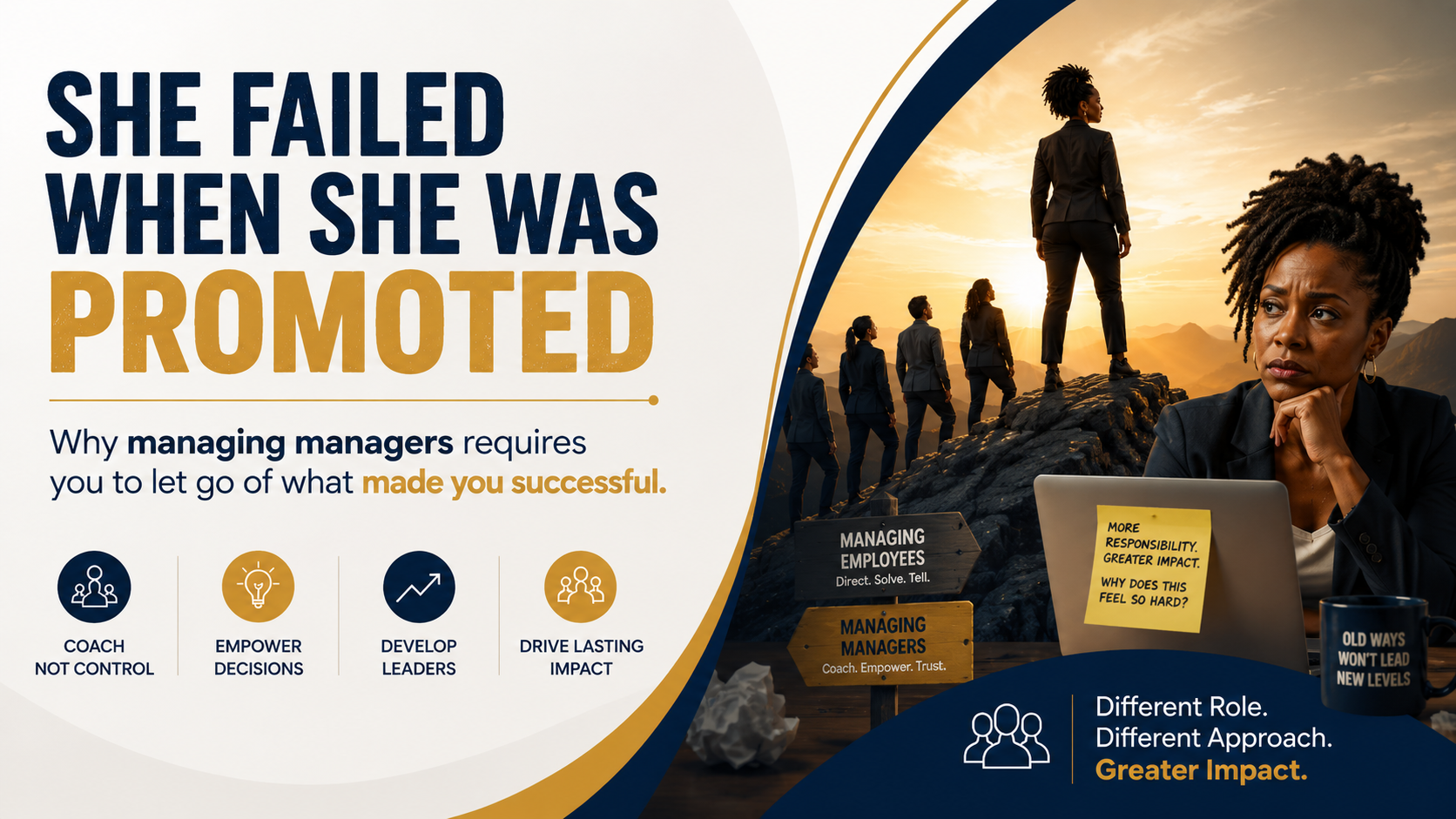
She Failed When She Was Promoted
Many leadership development programs prepare people to become managers. Few prepare them for the next transition: managing managers. Yet this is one of the most significant leadership shifts the we will experience in our careers.
The skills that made you successful leading individual contributors can become the very behaviours that limit your effectiveness when leading other leaders.
Recently, I coached a senior IT leader, whom I'll call Brenda, who was navigating this exact transition.
For years, Brenda led technicians and coordinators. She loved developing people, solving problems with them, and watching their confidence grow. For her, nothing was more rewarding than seeing someone apply her guidance and succeed.
Then, on January 31, everything changed. She was given responsibility for an entirely new team; a team of managers.
During one of our coaching conversations, she smiled and said, "My babies have grown up."
We both laughed, but beneath the humour was discomfort. Beyond learning a new role, she needed to redefine what her leadership meant.
Managing Managers Requires a Different Mindset
When we lead individual contributors, our value often comes from our expertise and experience.
We have walked the path before and it is easy for us to answer questions, solve problems, remove obstacles, and provide direction.
When managing managers, those same behaviours can unintentionally reduce accountability ownership and initiative.
During our session Brenda shared a powerful metaphor "When I managed technicians, I gave them a flower. Now I have to present a bouquet and let my managers choose the flowers they need."
She realised that when leading managers she didn’t need to provide the answer; she needed to expand the options.
She further explained "I used to paint the picture. Now I need to hand them a blank canvas and trust them to create something of their own."
Her new role required her to develop leaders who can think, decide, and lead independently.
The Stakes Feel Higher
Despite these insights, Brenda still felt uncomfortable.
"What is the source of your discomfort?" I asked.
"My risk profile has changed," she replied.
She shared that while a technician's mistake usually affects one task, a manager's decision influences an entire team. She felt the need to become more involved in every manager's decisions because the consequences of errors were greater.
Hers was a natural response.
The greater the perceived risk, the greater the temptation to micromanage. It seems counter intuitive to give a blank canvas and a bouquet, yet that is exactly what leaders need to do.
How can you create the conditions for them to make good decisions ont heir own?"
She answered strengthen her coaching, ask better questions, and develop decision-making capability ( in their teams) instead of dependency.
When Support Becomes Micromanagement
As we reflected on her previous leadership style, Brenda recognised another contradiction.
Whenever she coached technicians, after the event, she followed up questions to support learning:
How did it go? What happened next? How else can I assist?
Managers interpreted those same questions as micromanagement - another signal that she needed to shift focus from controlling outcomes to building leadership capability.
Coaching Is a Leadership Mindset
Like many leaders, Brenda scheduled regular one-on-one meetings with her team members and unintentionally limited her coaching to these meetings.
She now embraced coaching as a leadership mindset, that she walked into every room with. Whether it was problem solving or a project discussion she needed to choose curiosity over instruction and questions over answers.
Coaching was now one of the everyday tools she would use in her leadership.
Leadership Extends Beyond the Workplace
When we met again, Brenda shared that her managers had noticed thedifference.
They now felt trusted and were making more of their own decisions.
Several commented that her new approach felt more sustainable.
What surprised her most, was that the learning followed her home.
Her instinct had always been to step in and solve problems for her teenagers.
Now she found herself asking more questions, encouraging their independence,and supporting rather than rescuing.
The same coaching mindset that was transforming her leadership at work wasstrengthening her leadership at home.
The Real Reward of Managing Managers
Despite her progress, I noticed Brenda seemed unsettled and unresolved.
"What makes this not feel like a win?"
She paused,"It feels like I'm losing something."
"What are you losing?"
She reflected for a moment.
"I miss the gratitude from the technicians. I miss watching people grow from the very beginning. I miss seeing immediate progress."
"What might you be gaining instead?"
That question shifted the conversation.
She realised that instead of developing one person, she was developing leaders who would influence dozens of others. Though less immediate, her impact had become far greater.
Conclusion
Leadership is about transitions that require us to examine and let go of the habits that once made us successful.
When we have to manage managers or senior leads we need to shift from asking, "How can I solve this problem?" To ask "How can I develop others to solve problems without me?"
That is the shift no one prepares you for. That is the shift that will define your leadership.
What shifts do you need to make with your leadership?


